Construction

Bearing with cylindrical bore

Bearing accessories and bearing retention

Bearing accessories such as bearing shaft bolts, shaft nuts and bearing adapter sleeves play an important role in the installation of rolling bearings. Especially when attached to a housing or shaft, it ensures secure mounting that lasts a long time. However, there are a few aspects to consider during assembly and disassembly. This article will guide you through some common bearing retention methods and what to consider when installing and using them.

5 Minutes read

Technical guide to bearing selection for rotating shafts and torsion shafts

Shafts are a key element of almost any machine. In order for these components to function reliably, the bearings that carry these shafts must be perfectly matched to the respective application and installation situation. The selection of a suitable shaft bearing (rotary bearing) therefore has a significant impact on the service life and energy efficiency of a machine as well as its noise generation and maintenance requirements.

But which type of bearing is the right one for a particular shaft?

This guide shows how to select the optimal bearing solution for rotating and torsion shafts based on technical criteria and practical framework conditions.

14 Minutes read

Flat Head Screws - Advantages and application examples

Flat head screws are a special type of screw with a low, flat head. They are used in applications where the screw head cannot protrude far beyond the surface. Despite their low head height, they provide uniform load distribution, minimizing point loads and material stresses.

6 Minutes read

Damping Materials - Rubber and PU Rubber

Effective damping of mechanical oscillations, shocks and vibrations is a central criterion in the design of technical systems. Materials such as rubber and polyurethane rubber (PU) are characterized by high damping power, viscoelastic behavior and adjustable mechanical characteristics. Their targeted selection and modification allow for application-specific adaptation to dynamic loads, environmental conditions and service life requirements. We highlight the typical material properties, use cases and current developments in the area of damping polymer materials.

21 Minutes read

Profile Rail Guides - Selection Tool for Linear Guides

Selecting the right profile rail guide has a lasting impact on the performance and longevity of machines and equipment. But how do you find the right system among a wide range of options? Check out our blog to see what criteria really matter, from load types and accuracy requirements to environmental and installation conditions. We will show you a structured approach to help you make informed decisions and to optimize the performance of your applications over the long term.

9 Minutes read

Profile Rail Guides - Precision Standards of MISUMI Profile Rail Guides

What makes a linear guide profile rail guide the first choice for precise and resilient motion control? In our blog, you will learn all about the design, the different versions, dimensional tolerances and the key parameters, such as running parallelism, preload and axial play. We show how these features work together perfectly to ensure the highest precision and durability – and how you can best match these components to your needs.

11 Minutes read

Linear shafts: shaft ends and mounting options for linear shafts

The fastening mechanisms for linear shafts or guide shafts in mechanical systems require careful planning. Different shaft ends permit different mounting options. This article provides an overview of available shaft ends and answers the question of which shaft holders or shaft support options are available and where they are appropriate. As part of this, we also take a detailed look at the fixed and floating bearing types for shafts.

12 Minutes read

Calculating the center of mass - with examples

Calculating the center of mass is an important step in many tasks in mechanical engineering and in the design of machines and components. The center of mass indicates where the weight of a body is concentrated and thus permits determining the forces and moments in the system. This article explores the basics of calculating the center of mass and provides some real-world examples.

7 Minutes read

Spring design calculations

Springs are mechanical components that can store and deliver tension energy generated by the work used to tension, elongate or compress the spring in the form of deformation or tension energy. They are used in many applications and can be found in small electronic components as well as in large industrial machines. To ensure that a spring performs its function, it must be correctly designed. For this purpose, parameters such as the spring constant and the spring travel are calculated.

7 Minutes read

Complete solutions for linear motion - linear units, linear modules and linear actuators

Linear motion allows loads to move in a straight line path instead of rotating loads about an axis. This is an important part of industrial automation.

6 Minutes read

Spacer sleeves and spacer discs – Materials and shapes

Spacer sleeves and spacer discs are important elements for joining and design engineering solutions. They perform several tasks: They are spacers, distribute incident forces, secure components and are needed for precision adjustments. In addition to classic metal washers, this article also discusses other special shapes and configuration options, such as round plates.

16 Minutes read

Linear ball bearings – Selection, installation and maintenance

Linear ball bearings are important components in many mechanical engineering applications. The function of linear ball bearings is to enable precise and low friction movement along an axis. This article provides important guidance on the selection, installation and maintenance of linear ball bearings, so you can be sure to find the right bearing for your application and get the most out of it.

11 Minutes read

Ball bearings – Load distribution for rolling bearings

Ball bearings and other rolling bearings are installed in numerous machines. The installed bearings transfer the radial or axial forces that occur to the machine housing and thus permit the use of various moving components. The forces that occur and the resulting load in the bearing must already be determined during the design process. The load distribution in the bearing and the matching contact point geometry is crucial for the expected service life, function and efficiency of the bearing. In this article, we will look at the load exerted on a rolling bearing and how contact surface geometry affects load distribution in the rolling bearing.

10 Minutes read

Specialty plastics for practitioners – Properties, resistance and application examples

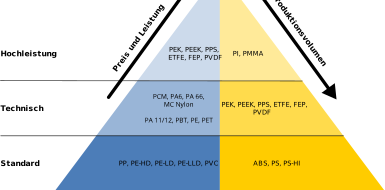
Specialty plastics are used when applications place high demands on the material or special properties are required. They frequently have insulating properties and their high resistance to water and chemicals makes them a reliable, low-maintenance material. It is then no wonder that specialty plastics are used in many technical fields and also in fasteners such as screws and nuts. The following article provides an overview of various specialty plastics and their applications.

12 Minutes read

Linear motion components - Things worth knowing about guides, screw drives and more

These include linear motors, linear actuators, linear axes, and other components that allow linear motion. Linear motors are specially designed motors that generate linear motion. They generate forces to move loads along a linear track.

10 Minutes read

Gripper Systems for Material Handling in Mechanical Engineering

Particularly in large production plants and production chains, it is imperative to deal with handling techniques for materials and workpieces. Due to the weight alone, it is e.g. almost impossible to move materials manually. This is where material handling starts: Gripper systems or conveyor belts, for example, facilitate the movement and control of materials and increase efficiency. In the following, we will take a closer look at various gripper systems and how they are utilized.

10 Minutes read

inCAD Library – A Designer’s Source of Inspiration

The inCAD Library is an extensive library for designers offering many application examples. The library provides freely application examples for functions or product possibilities. Each application example contains a parts list of the parts MISUMI has available together with information on the quantity required for the example. For designers, the CAD models serve as a source of inspiration for modifying, meaningfully adding and adapting them for their own machines or systems.

6 Minutes read

Milled parts as freely configurable components through Make-to-Order – Flexibility in contract manufacturing

Make-to-Order (MTO) is the classic production process for customised production. Make-to-Order means contract manufacturing. In this process, production takes place according to individual customer requirements and only begins after the customer has placed an order. Unlike Make-to-Stock (MTS), where production and stock levels are pre-determined, MTO components are only manufactured after receipt of a customer order.

7 Minutes read

Turned parts – Precisely configurable Make-to-Order (MTO) components

Make-to-Order (MTO) turned parts and components are an important part of the modern manufacturing industry. Make-to-Order means contract manufacturing. This means that production only begins when a specific order is available. In contrast to Make-To-Stock (MTS), where products are produced for stock, MTO components are only manufactured after order receipt.

6 Minutes read

Types, properties and utilization of retaining rings

The retaining ring is one of the most important tools in construction. It is used to secure individual components and prevent axial movement. In this article, we will take a look at the different types of retaining rings, their features and their utilization.

3 Minutes read