Currently there are no notifications.
Bearing accessories and bearing retention
Bearing accessories such as bearing shaft bolts, shaft nuts and bearing adapter sleeves play an important role in the installation of rolling bearings. Especially when attached to a housing or shaft, it ensures secure mounting that lasts a long time. However, there are a few aspects to consider during assembly and disassembly. This article will guide you through some common bearing retention methods and what to consider when installing and using them.
Bearing Accessories: Components
Bearing accessories include a variety of components necessary for the proper installation, securing and maintenance of rolling bearings. These include:
Bearing shaft bolts
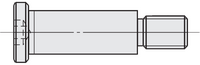
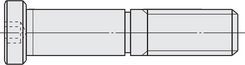
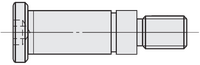
Bearing shaft bolts are special screws that are optimized for the precise mounting of a rolling bearing. They serve as a bearing element for the rolling bearing and thus allow mounting on the face of shafts or in housings. While a retaining ring can secure the rolling bearing against axial displacement when designed with a retaining ring groove, a suitable spacer or another means of axial fixation must be used for variants without a ring groove.

Shaft nuts
In combination with clamping and loose bearings, shaft nuts provide secure connections between the bearing and shaft. In order to improve the fixation, they are often equipped with additional locking elements such as locking plates or locking rings. A special design is radial insert ball bearings, for which no bearing lock nut is necessary

Bearing adapter sleeves
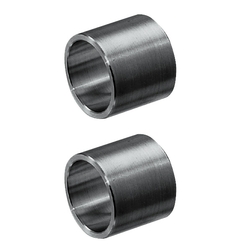
Bearing adapter sleeves are precision-engineered sleeves that are placed in a hole or on a shaft to match the diameter to a common rolling bearing. They are available, to fit shafts of various diameters, in a version for the rolling bearing inner ring with positive and negative tolerance. For bores, there is a version for the rolling bearing outer ring, which is also available with positive or negative tolerance.
Mounting Rolling Bearings with Bearing Accessories
When installing rolling bearings, precision and the choice of the right method are important. Improper or inadequate assembly can result in a reduction in service life, making it even more important to use the correct bearing accessories. Depending on the bore of the bearing and the design of the housing or shaft on which the bearing is to be mounted, there are different options here. Each method has its advantages and disadvantages and is recommended for different situations.
Cylindrical bore: Cold Mount and Press Fit
Cylindrical bore bearings are often secured to a shaft using a press fit, clamping sleeve, or bearing adapter sleeves. It is important to use the appropriate mounting tool to prevent damage to the bearing and shaft. Sleeves, clamping rings and spacers ensure precise positioning and secure fastening. Clamping sets offer a particularly easy installation here.


Tapered bore: Clamping Sleeves and Hydraulic Methods
Conical bore bearings are usually mounted on a cylindrical shaft with a bearing adapter such as a withdrawal sleeve or directly on a conical shaft. The hydraulic method can also be used here for particularly efficient and uniform mounting. The necessary preload can be precisely controlled using hydraulic nuts or hydraulic presses.

1 = outer ring
2= inner ring
3= clamping screw
4= hub
5= shaft
Disassembly of rolling bearings with bearing accessories
In particular, incorrectly assembled rolling bearings pose safety risks during disassembly. It is all the more important to ensure proper work during assembly to prevent damage to people and material. Careful disassembly plays an equally important role.
Mechanical disassembly
For smaller bearings, mechanical disassembly with extraction tools is often recommended. Two-arm or three-arm pullers are used to gently disengage the bearing from the shaft. If controlled force is necessary, impact sleeves or soft-face hammers can also be used.
Hydraulic disassembly
For larger or tapered bore bearings, hydraulic disassembly with hydraulic nuts or hydraulic presses is recommended. Thanks to the targeted pressurization, the bearing can be released from the shaft smoothly and without damage.

Thermal disassembly
Thermal disassembly may be helpful if a bearing is tight, for example due to corrosion or a strong press fit. The bearing is heated specifically to loosen it. A controlled increase in temperature is particularly important in order to avoid material changes.
Other bearing shaft bolt applications
In addition to the assembly of rolling bearings, bearing shaft bolts are used in various structural mounting approaches, such as guide rollers and cam rollers. An application example here is the automated production line, where cam rollers are guided along a path, while bearing shaft bolts securely fasten the rollers to the machine structure. In any case, it is important to tighten the screws according to the specifications and to use suitable elements such as safety washers or shaft nuts to ensure a secure installation.