Currently there are no notifications.
Pneumatic Couplings and Pneumatic Pipe Fittings
Pneumatic couplings are used in pneumatic systems to connect and disconnect hoses and pipes. What types of pneumatic couplings or Which quick connectors are available, whether they are compatible with each other, and which hoses can be connected to them, you can find out in this article. In addition, the assembly and aspects of occupational safety are discussed, since there is sometimes very high pressure in pneumatic systems.
What are pneumatic couplings?
Pneumatic couplings are used to connect hose material in pneumatic systems. In principle, couplings are always non-destructively detachable, while connectors can be either detachable or not detachable without being destroyed. However, in practice, people often speak of couplings when they mean hose connectors that are often removable without damaging the connected hoses.
Quick connectors, also known as push-in connectors, refer to connectors where the end of the hose or tubing can be easily inserted into the connector and then automatically sealed and held in the connector. They are therefore particularly easy to connect and disconnect.
| Permitted fluid | Example image | Matching tube parts, fittings | Operating temperature range | Operating vacuum | Max. operating pressure | Fitting series | Connector series | |||||||||||||||||||||||||||||||||||||||||||||||||||||||||||||||||||||||||||||||||||||||||||||
|---|---|---|---|---|---|---|---|---|---|---|---|---|---|---|---|---|---|---|---|---|---|---|---|---|---|---|---|---|---|---|---|---|---|---|---|---|---|---|---|---|---|---|---|---|---|---|---|---|---|---|---|---|---|---|---|---|---|---|---|---|---|---|---|---|---|---|---|---|---|---|---|---|---|---|---|---|---|---|---|---|---|---|---|---|---|---|---|---|---|---|---|---|---|---|---|---|---|---|---|---|
| Air (Some for water) |
 |
Push-in connectors (quick-connect fittings) Page 1: Push-in connection Page 2: various types / also as manifolds |
0 to 60 °C | -100 kPa | 0.9 MPa | Elbow: MSELL Straight: MSCNC And many more |
Elbow: USEBL Straight: UJDST Tee: USTEL Manifold: USYL |
|||||||||||||||||||||||||||||||||||||||||||||||||||||||||||||||||||||||||||||||||||||||||||||
| Air |  |
Push-in connectors (mini quick-connect fittings) Page 1: Push-in connection for OD D = 4 and 6 mm Page 2: various types / also as manifolds |
0 to 60 °C | -100 kPa | 1 MPa | Elbow: MNCNL Straight: MNCNP |
Elbow: MNCLYL Straight: MNUN Tee: MNCLYT Manifold: MNUNY |
|||||||||||||||||||||||||||||||||||||||||||||||||||||||||||||||||||||||||||||||||||||||||||||
| Air |  |
Mini hose fittings for plastic hoses (slip-on type) Page 1: Connection for hose ID D = 2.5 and 4 mm Page 2: various types / also as manifolds |
0 to 50 °C | -100 kPa | 0.5 MPa | Straight: SRTG | - | |||||||||||||||||||||||||||||||||||||||||||||||||||||||||||||||||||||||||||||||||||||||||||||
| Air |  |
Quick fitting (hose fitting for plastic hoses) Page 1: Compression fitting Page 2: various types / also as manifolds |
0 to 50 °C | -100 kPa | 1.0 MPa | Straight: SRTN | - | |||||||||||||||||||||||||||||||||||||||||||||||||||||||||||||||||||||||||||||||||||||||||||||
| Air |  |
Push-in connectors Compact air fittings Page 1: Push-in connection for OD D = 1.8 mm Page 2: various types / also as manifolds |
-10 to 60 °C | -100 kPa | 0.8 MPa | Elbow: JELL Straight: JCNL |
Straight: JBUL Tee: JTEL Reducer: JRDS Flow control: JNL |
|||||||||||||||||||||||||||||||||||||||||||||||||||||||||||||||||||||||||||||||||||||||||||||
| Air, water |  |
Push-in connectors (stainless steel) for PU hoses (MPUT) Page 1: Push-in connection for OD D = 4, 6, 8, 10 and 12 mm Page 2: various types / also as manifolds |
-15 to 120 °C (No frost) |
-100 kPa | 1 MPa | Elbow: MLELLSS Straight: MLCNLSS |
Elbow: UNEBLS Straight: UNSTLS Tee: UNTELS |
|||||||||||||||||||||||||||||||||||||||||||||||||||||||||||||||||||||||||||||||||||||||||||||
| Air, water |  |
Push-in connectors (heat-resistant) Page 1: Push-in connection for OD D = 4, 6, 8, 10 and 12 mm Page 2: various types / also as manifolds |
0 to 100 °C | -100 kPa | 1 MPa | Elbow: KPMCL Straight: KPMCC |
- | |||||||||||||||||||||||||||||||||||||||||||||||||||||||||||||||||||||||||||||||||||||||||||||
| Air, water | |
Push-in connectors (high-temp resistant) Page 1: Push-in connection for OD D = 4, 6, 8, 10 and 12 mm Page 2: various types / also as manifolds |
0 to 120 °C | -100 kPa | 1 MPa | Elbow: KKMCS Straight: KKMCL |
- | |||||||||||||||||||||||||||||||||||||||||||||||||||||||||||||||||||||||||||||||||||||||||||||
| Air, water, Chemicals |
 |
Push-in connectors for applications with high cleanliness requirements Page 1: Push-in connection for OD D = 4, 6, 8, 10 and 12 mm Page 2: various types / also as manifolds |
0 to 80 °C | -100 kPa | 0.9 MPa | Elbow: PPCR Straight: PPCNL |
Elbow: PPCL Straight: PPCR Tee: PPCE Manifold: PPCY Reducer: PPCGY |
|||||||||||||||||||||||||||||||||||||||||||||||||||||||||||||||||||||||||||||||||||||||||||||
| Air |  |
Push-in connectors, swivel Page 1: Push-in connection for OD D = 4, 6, 8 and 10 mm Page 2: Male thread, metric |
0 to 60 °C | -100 kPa | 1.0 MPa | Elbow: RTCNL Straight: RTCN |
- | |||||||||||||||||||||||||||||||||||||||||||||||||||||||||||||||||||||||||||||||||||||||||||||
| Air |  |
Push-in connectors, swivel, long Page 1: Push-in connection for OD D = 4, 6 and 8 mm Page 2: Male thread, metric |
0 to 60 °C | -100 kPa | 1.0 MPa | Elbow: RHTCNL Straight: RHTCN |
- | |||||||||||||||||||||||||||||||||||||||||||||||||||||||||||||||||||||||||||||||||||||||||||||
| Air, water |  |
Compression fitting with integrated nut and ferrule Page 1: Compression fitting Page 2: various types / also as manifolds |
0 to 80 °C *Depends on current material. |
-100 kPa | Max. operating pressure equals hose operating pressure. | Elbow: TCRL Straight: TCRH |
Elbow: TCRF Straight: TCRS Tee: TCRT |
|||||||||||||||||||||||||||||||||||||||||||||||||||||||||||||||||||||||||||||||||||||||||||||
| Ultra-pure water, Acid, alkali, Organic solvents |
 |
Quick fitting for PFA, PTFE, FEP hoses Fluoroplastic material Page 1: Compression fitting Page 2: various types / also as manifolds |
0 to 100 °C | - | 0.2 to 0.8 MPa (Depends on hose OD) |
Elbow: FEMLT Straight: FENL Straight with through-hole: FECT |
Elbow: FEUE Straight: FETP Tee: FEUT Reducer: FEUR |
|||||||||||||||||||||||||||||||||||||||||||||||||||||||||||||||||||||||||||||||||||||||||||||
| Air, water and oil |
 |
Compression fittings with plastic insert for hoses Page 1: Compression fitting Page 2: various types / also as manifolds |
-20 to 60 °C (Air) 0 to 60 °C (Water) -20 to 60 °C (Oil) |
-100 kPa | Max. operating pressure equals hose operating pressure. | Elbow: TCRL Straight: TCRH |
Elbow: TCRF Straight: TCRS Tee: TCRT |
|||||||||||||||||||||||||||||||||||||||||||||||||||||||||||||||||||||||||||||||||||||||||||||
| ||||||||||||||||||||||||||||||||||||||||||||||||||||||||||||||||||||||||||||||||||||||||||||||||||||
However, the coupling usually refers to the element connected to the pressurized hose, which is intended to make the line easy and quick to connect and disconnect. There are a variety of different systems, so only some of them can be considered here.
The connector types for the line/hose assembly include:
- Quick-connect connections
- Quick fitting (threaded hole or external thread)
- Cutting ring fitting
- Connection with hose fitting
The term fitting, which is also common in Germany for fluid-carrying systems, is derived from the English verb "to fit" meaning "matching". Here, it refers to fittings that allow for adaptation from one system to another.
Pneumatic couplings usually consist of a coupling body and a plug-in nipple. The nipple is inserted into the coupling and is thus automatically securely locked. The release operates via a mechanism that requires little force. This makes pneumatic couplings a versatile connection option that allows for a particularly easy and quick replacement. Long downtimes can thus be avoided. Quick connectors also offer greater safety compared to screw connections. However, when disconnecting pressurized connections, there is always a risk of a whipping effect, so it is recommended to use a safety coupling that allows the overpressure to escape before opening.


There are different types of pneumatic couplings. These include:
- Quick fitting joints that are particularly easy to connect and disconnect thanks to a spring mechanism
- Bayonet couplings, in which a twist lock secures against loosening
- Screw couplings commonly used in high-pressure applications because they provide a high level of leak tightness
- One-handed couplings used when an application requires a very simple one-hand operation
Suitable hose materials
It is important to choose the appropriate hose material for the functionality and life of a pneumatic system. The hose material is suitable for the application area if it is externally calibrated, has a sufficient wall thickness, and a sufficiently high Shore hardness. Selecting the right material depends on the specifications of the application, especially in terms of pressure, temperature, and chemical resistance. Polyurethane, polyamide or polyethylene hoses are generally particularly well suited.
| Type | PUT / PUTL | PUTY / PUTYL | PUVFN / PUVFLN | |||||||
| Pic |  |
 |
 |
|||||||
| Material | Polyurethane rubber | Soft polyurethane | Soft polyurethane | |||||||
| Fluid | Air | Water | Vacuum use | Air | Vacuum use | Air | Vacuum use | |||
| Temp. spec. | -5 to 60 °C | 0 to 40 °C | -5 to 60 °C | -5 to 60 °C | -15 to 50 °C | |||||
| Burst | 3.0 MPa | - | 1.7 MPa | - | 1.3 MPa | - | ||||
| Max. pressure | 0.8 MPa | 0.3 MPa | - | 0.4 MPa | - | 0.4 MPa | - | |||
| Vacuum | - | -100 kPa | - | -100 kPa | - | -100 kPa | ||||
| Features | • Water-resistant • More flexible than nylon tubes with a smaller bend radius • High mechanical strength (esp. wear resistance) |
• Nearly as flexible as silicone tubes, but easier to handle than polyurethane tubes • High mechanical strength (esp. wear resistance) |
• Tubes with high flexibility and flex-life • Hard to bend or coil, ideal for piping in vibrating parts like suction units |
|||||||
| Type | PUAS / PUASL | PUTMF / PUTMFL | PUTS / PUTSL | |||||||
| Pic |  |
 |
 |
|||||||
| Material | Conductive polyurethane | Polyurethane (multi-core) | Flameproof polyurethane | |||||||
| Fluid | Air | Vacuum use | Air | Vacuum use | Air | Water | Vacuum use | |||
| Temp. spec. | -5 to 60 °C | -5 to 60 °C | -5 to 60 °C | 0 to 80 °C | -5 to 60 °C | |||||
| Burst | 3.0 MPa | - | 3.0 MPa | - | 3.0 MPa | - | ||||
| Max. pressure | 0.8 MPa | - | 0.8 MPa | - | 0.8 MPa | 0.3 MPa | - | |||
| Vacuum | - | -100 kPa | - | -100 kPa | - | -100 kPa | ||||
| Features | • For uses where static electricity is unwanted • Surface resistance max. 1010 Ω |
• Suited for multi-lines to double-acting cylinders, etc. • Easy to strip and connect to fittings without prep |
• Connects to fittings without covering or stripping • Fast charring on contact with hot spatter prevents melt holes |
|||||||
| Type | PUTHP / PUTHPL | PUTNS / PUTNSL | PUTN / PUTNL | |||||||
| Pic |  |
 |
 |
|||||||
| Material | Polyamide (nylon) | Nylon | Nylon | |||||||
| Fluid | See temp. range | Air | Water | Vacuum use | Oil | Air | Water | Vacuum use | ||
| Temp. spec. | -40 to 120 °C (Air, oil) 0~80 °C (Water) |
-15 to 90 °C (frost-proof) | -5 to 40 °C | -40 to 100 °C | 0 to 80 °C | -5 to 100 °C | ||||
| Burst | Depends on size. See tech. data. | 2.0 MPa | - | Depends on size. See tech. data. | - | |||||
| Max. pressure | Depends on size. See tech. data. | 1.0 MPa | 0.3 MPa | - | Depends on size. See tech. data. | - | ||||
| Vacuum | - | - | -100 kPa | - | -100 kPa | |||||
| Features | • Oil-resistant • Can be used instead of copper pipes |
• Excellent pressure, abrasion, weather and cold resistance, plus flexibility • Suited for narrow high-pressure lines |
• Oil-resistant • High mechanical strength (esp. wear resistance) |
|||||||
| Type | PUJTF / PUJTFL | PUTFB / PUTFBL / PUTFG / PUTFGL | PUTF / PUTFL / PUFN | |||||||
| Pic |  |
 |
 |
|||||||
| Material | Fluoroplastic (ETFE) | Fluororubber | Fluoroplastic | |||||||
| Fluid | Air, water | Oil | Air | Water | Air | Water | Vacuum use | |||
| Temp. spec. | -20 to 80 °C 0~80 °C (Water) |
-20 to 180 °C | -65 to 260 °C | |||||||
| Burst | See tech. data. | Depends on size. See tech. data. | Depends on size. See tech. data. | |||||||
| Max. pressure | See tech. data. | Depends on size. See tech. data. | Depends on size. See tech. data. | |||||||
| Vacuum | - | - | - | -100 kPa | ||||||
| Features | • High chemical resistance • High transparency allows visual check of contents |
• High heat, oil, weather and chemical resistance • High resistance to ozone and light |
• High temperature resistance • Inert to most corrosive gases, chemicals and solvents • Weather-resistant, long life • Non-flammable, no toxic emissions |
|||||||
| Type | PUTC / PUTCL | PORF / PORFL | ||||||||
| Pic |  |
 |
||||||||
| Material | Silicone rubber | Polyolefin | ||||||||
| Fluid | Water | Air | Water | Vacuum use | ||||||
| Temp. spec. | -30 to 150 °C | -20 to 60 °C | 0 to 40 °C | -20 to 60 °C | ||||||
| Burst | - (Elastic body. Not for pressure use.) | 2.0 MPa | - | |||||||
| Max. pressure | - (Elastic body. Not for pressure use.) | 0.5 MPa | - | |||||||
| Vacuum | - (Elastic body. Not for pressure use.) | - | -100 kPa | |||||||
| Features | • High temperature resistance • Keeps elastic-body properties within the above temperature range • Also suited for areas with special hygiene requirements |
• Water-resistant • Low relative density and light weight • Disposal without harmful gas emission • Also suited for areas with special hygiene requirements |
||||||||
Classification of quick connectors
In general, quick connectors can be categorized into single-sided and double-sided locking connectors. In the one-sided locking variant, the medium can escape when the connection is disconnected on one side, as the coupling plug remains open while the coupling socket is closed. With quick connectors that are locked on both sides, the flow is stopped when disconnecting. Other categories include:
- Plug connectors
- Hose connections
- Clamp and cutting ring fittings

1= hose
2= Use for soft hoses
3= Release mechanism
C= Insertion depth of the hose
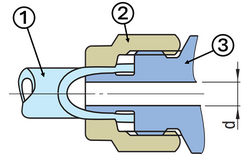
1= hose
2= Clamp nut
3= Base body with integrated clamping sleeve

Special design with chemical resistance
For applications requiring high chemical resistance, MISUMI offers special quick-connect fluoropolymer fittings.
Compatibility of the individual systems with each other
The compatibility of the systems with each other depends on different influencing factors:
- Size
- Manufacturer Specifications
- Sealing Mechanisms
- Pressure and Temperature Ranges
- Material incompatibilities
The rule of thumb is: For a secure and tight connection, connectors of the same type and manufacturer should be used to avoid the risk of leaks and malfunctions.

Installation instructions
When installing pneumatic couplings, there are a few things to keep in mind to ensure occupational safety and a safe and long-lasting connection. You should first ensure that the coupling and hose are matched and that the seals are not damaged.

1= Electromagnetic 5-way valve
2= Plug
3= Speed control (regulator outlet)
4= Double-acting cylinder
5= Air hose
6= Silencer
7= Plug
First, the hose material must be shortened to the appropriate length. Special care must be taken to cut the end of the hose at a right angle so that the hose can be completely enclosed by the connector. The end of the hose must be inserted straight into the coupling without much force until the hose is securely seated. In doing so, rotational movements must be avoided, as this can affect the sealing effect.

Detachment of the pneumatic push-in coupling is generally possible without problems by pressing the release ring, depending on the design of the coupling. The coupling should then be easy to pull apart. However, a release tool can also be used.
Occupational safety when releasing pressure connections
Uncontrolled release of compressed air can result in injury when the pressure connection is released. Special caution is therefore required. Residual pressure vents can be a helpful tool to minimize these hazards by releasing any residual pressure from the system prior to disconnection.